Data-Centric AI
Model-centric에서 Data-centric으로의 패러다임 전환. 모델 아키텍처 개선보다 데이터 품질 향상에 집중하는 AI 개발 방법론.
개요
핵심 개념
Data-Centric AI란?
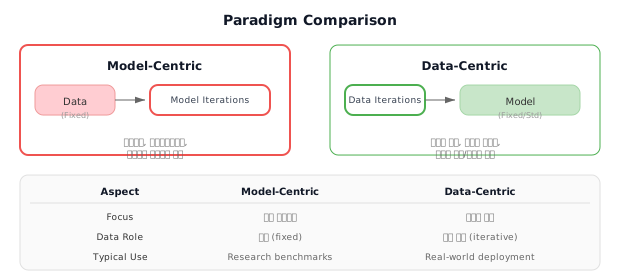
기존 ML 개발은 데이터를 고정하고 모델을 개선하는 "Model-Centric" 접근이었다. Data-Centric AI는 이와 반대로, 모델을 고정하고 데이터를 체계적으로 개선하여 성능을 향상시킨다.
"In real-world AI projects, improving data quality often yields better results than improving models." — Andrew Ng
Meta
| Item | Value |
|---|---|
| Category | ML Methodology / Data Engineering |
| Proposed By | Andrew Ng et al. (2021) |
| Key Conferences | NeurIPS 2024, ICML 2024 |
| Key Surveys | Zha et al. (2023), Jarrahi et al. (2024) |
Model-Centric vs Data-Centric
왜 Data-Centric인가?
| 인사이트 | 설명 |
|---|---|
| 데이터 품질 병목 | 실제 프로젝트에서 80% 이상의 시간이 데이터 준비에 소요 |
| 모델 성숙도 | SOTA 모델들의 성능 차이가 점점 줄어듦 |
| Long-tail 문제 | 소수 클래스, 엣지 케이스에서 데이터 개선이 더 효과적 |
| 재현성 | 데이터 품질 이슈가 모델 성능 변동의 주요 원인 |
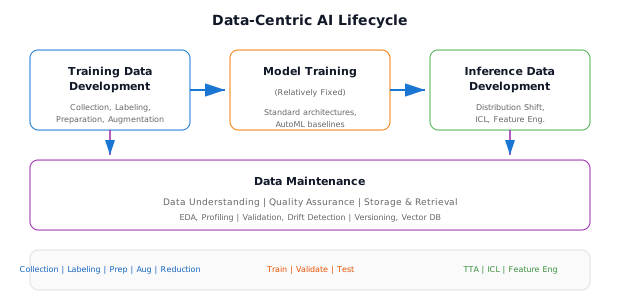
Data Lifecycle Framework
1. Training Data Development
| Task | Description | Methods |
|---|---|---|
| Data Collection | 데이터 수집 전략 | Active Learning, Web Scraping, Crowdsourcing |
| Data Labeling | 레이블 생성/검증 | Weak Supervision, Programmatic Labeling |
| Data Preparation | 전처리, 정제 | Cleaning, Normalization, Deduplication |
| Data Augmentation | 데이터 증강 | Mixup, CutMix, Synthetic Generation |
| Data Reduction | 데이터셋 축소 | Core-set Selection, Dataset Distillation |
2. Inference Data Development
| Task | Description | Methods |
|---|---|---|
| Distribution Shift | 분포 변화 대응 | Domain Adaptation, TTA |
| In-Context Learning | 프롬프트 예시 선택 | Example Selection, Prompt Engineering |
| Feature Engineering | 피처 변환/생성 | AutoFE, Feature Selection |
3. Data Maintenance
| Task | Description | Methods |
|---|---|---|
| Data Understanding | 데이터 탐색/분석 | EDA, Data Profiling |
| Quality Assurance | 품질 모니터링 | Data Validation, Drift Detection |
| Storage & Retrieval | 저장/검색 최적화 | Data Versioning, Vector DB |
Key Techniques
1. Data Quality Auditing
SELFCLEAN (NeurIPS 2024): Self-supervised representation을 활용한 데이터 품질 진단.
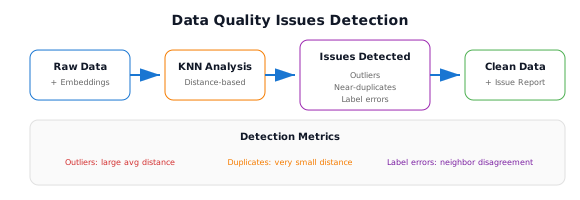
구현 예시:
from sklearn.neighbors import NearestNeighbors
import numpy as np
from typing import Dict, List, Tuple

def detect_quality_issues(
    embeddings: np.ndarray,
    labels: np.ndarray,
    k: int = 10
) -> Dict[str, List]:
    """
    임베딩 거리 기반 데이터 품질 이슈 탐지

    탐지 가능한 이슈:
    - Off-topic samples (outliers)
    - Near duplicates
    - Label errors (neighbors with different labels)

    Args:
        embeddings: (n_samples, embedding_dim) 형태의 임베딩
        labels: (n_samples,) 형태의 레이블
        k: KNN의 이웃 수

    Returns:
        각 이슈 유형별 인덱스 딕셔너리
    """
    nn = NearestNeighbors(n_neighbors=k+1, metric='cosine')
    nn.fit(embeddings)
    distances, indices = nn.kneighbors(embeddings)

    issues = {
        'outliers': [],
        'duplicates': [],
        'label_errors': []
    }

    # 평균 거리 계산 (자기 자신 제외)
    avg_distances = [np.mean(d[1:]) for d in distances]
    outlier_threshold = np.percentile(avg_distances, 95)

    for i in range(len(embeddings)):
        # 1. Outlier detection: 평균 거리가 95 퍼센타일 이상
        if avg_distances[i] > outlier_threshold:
            issues['outliers'].append(i)

        # 2. Near-duplicate detection: 가장 가까운 이웃과 거리 < 0.01
        if distances[i, 1] < 0.01:
            issues['duplicates'].append((i, indices[i, 1]))

        # 3. Label error detection: 이웃의 50% 미만이 같은 레이블
        neighbor_labels = labels[indices[i, 1:]]
        consistency = np.mean(neighbor_labels == labels[i])
        if consistency < 0.5:
            issues['label_errors'].append((i, consistency))

    return issues


# 사용 예시
from sentence_transformers import SentenceTransformer

# 임베딩 생성
encoder = SentenceTransformer('all-MiniLM-L6-v2')
texts = ["sample text 1", "sample text 2", ...]
embeddings = encoder.encode(texts)

# 이슈 탐지
issues = detect_quality_issues(embeddings, labels)

print(f"Outliers: {len(issues['outliers'])}")
print(f"Duplicates: {len(issues['duplicates'])}")
print(f"Label errors: {len(issues['label_errors'])}")
2. Data Valuation (Shapley-based)
데이터 포인트의 기여도를 정량화한다.
import numpy as np
from typing import Callable

def data_shapley(
    X_train: np.ndarray,
    y_train: np.ndarray,
    X_val: np.ndarray,
    y_val: np.ndarray,
    model_fn: Callable,
    n_samples: int = 100
) -> np.ndarray:
    """
    Monte Carlo 샘플링을 통한 Data Shapley 값 근사

    각 학습 데이터 포인트의 모델 성능 기여도를 측정

    Args:
        X_train, y_train: 학습 데이터
        X_val, y_val: 검증 데이터
        model_fn: 모델 생성 함수 (파라미터 없이 호출 가능)
        n_samples: Monte Carlo 샘플 수

    Returns:
        각 데이터 포인트의 Shapley 값
    """
    n = len(X_train)
    shapley_values = np.zeros(n)

    for _ in range(n_samples):
        # 학습 데이터의 랜덤 순열
        perm = np.random.permutation(n)

        prev_score = 0
        for j, idx in enumerate(perm):
            # 현재 포인트까지의 subset으로 학습
            subset = perm[:j+1]
            model = model_fn()
            model.fit(X_train[subset], y_train[subset])
            curr_score = model.score(X_val, y_val)

            # Marginal contribution
            shapley_values[idx] += (curr_score - prev_score)
            prev_score = curr_score

    return shapley_values / n_samples


def knn_shapley(
    X_train: np.ndarray,
    y_train: np.ndarray,
    X_val: np.ndarray,
    y_val: np.ndarray,
    k: int = 10
) -> np.ndarray:
    """
    KNN-Shapley: 효율적인 Shapley 값 근사 O(n log n)

    Reference: Jia et al., "Efficient Task-Specific Data Valuation" (2019)
    """
    from sklearn.neighbors import NearestNeighbors

    nn = NearestNeighbors(n_neighbors=min(k, len(X_train)))
    nn.fit(X_train)

    shapley_values = np.zeros(len(X_train))

    for x, y in zip(X_val, y_val):
        distances, indices = nn.kneighbors([x])
        indices = indices[0]

        for j, idx in enumerate(indices):
            # Shapley 가중치 계산
            weight = 1.0 / (j + 1) - 1.0 / (j + 2) if j < k-1 else 1.0 / k

            # 정답 여부에 따라 기여도 조정
            if y_train[idx] == y:
                shapley_values[idx] += weight
            else:
                shapley_values[idx] -= weight

    return shapley_values / len(X_val)


# 사용 예시: 저품질 데이터 식별
shapley_values = knn_shapley(X_train, y_train, X_val, y_val)

# 기여도가 낮거나 음수인 데이터 = 품질 문제 가능
low_value_idx = np.where(shapley_values < np.percentile(shapley_values, 10))[0]
print(f"Low-value samples: {len(low_value_idx)}")
3. Programmatic Labeling (Weak Supervision)
Labeling Function을 활용한 약한 감독 학습이다.
import numpy as np
from typing import Callable, List

# 상수 정의
ABSTAIN = -1
SPAM = 1
NOT_SPAM = 0

class LabelingFunction:
    """
    Labeling Function wrapper

    규칙 기반으로 레이블을 생성하는 함수
    ABSTAIN(-1)을 반환하면 해당 샘플에 대해 판단 보류
    """

    def __init__(self, name: str, fn: Callable[[str], int]):
        self.name = name
        self.fn = fn

    def __call__(self, text: str) -> int:
        return self.fn(text)


# Labeling Functions 정의 예시 (스팸 분류)
def lf_contains_free(text: str) -> int:
    """'free'가 포함되면 스팸"""
    return SPAM if 'free' in text.lower() else ABSTAIN

def lf_short_text(text: str) -> int:
    """짧은 텍스트는 스팸 아님"""
    return NOT_SPAM if len(text) < 20 else ABSTAIN

def lf_contains_click(text: str) -> int:
    """'click here'가 포함되면 스팸"""
    return SPAM if 'click here' in text.lower() else ABSTAIN

def lf_has_url(text: str) -> int:
    """URL이 많으면 스팸"""
    import re
    urls = re.findall(r'https?://\S+', text)
    return SPAM if len(urls) > 2 else ABSTAIN


def apply_lfs(
    texts: List[str],
    lfs: List[LabelingFunction]
) -> np.ndarray:
    """
    Labeling Functions를 적용하여 Label Matrix 생성

    Returns:
        L: (n_samples, n_lfs) 형태의 레이블 행렬
    """
    L = np.zeros((len(texts), len(lfs)), dtype=int)
    for i, text in enumerate(texts):
        for j, lf in enumerate(lfs):
            L[i, j] = lf(text)
    return L


def majority_vote(L: np.ndarray, abstain: int = -1) -> np.ndarray:
    """
    단순 다수결 Label Model

    Labeling Functions의 투표로 최종 레이블 결정
    """
    labels = []
    for row in L:
        votes = row[row != abstain]
        if len(votes) == 0:
            labels.append(abstain)
        else:
            labels.append(int(np.round(np.mean(votes))))
    return np.array(labels)


# 사용 예시
lfs = [
    LabelingFunction("free", lf_contains_free),
    LabelingFunction("short", lf_short_text),
    LabelingFunction("click", lf_contains_click),
    LabelingFunction("urls", lf_has_url)
]

texts = [
    "FREE! Click here to win!",
    "Hi, how are you?",
    "Check out these deals",
]

# Label Matrix 생성
L = apply_lfs(texts, lfs)
print("Label Matrix:\n", L)

# 최종 레이블
final_labels = majority_vote(L)
print("Final labels:", final_labels)

# 커버리지 분석
coverage = np.mean(np.any(L != ABSTAIN, axis=1))
print(f"Coverage: {coverage:.1%}")
4. Intelligent Data Augmentation
ConBias (NeurIPS 2024): Concept graph 기반 편향 탐지 및 타겟 증강.
from collections import defaultdict
import numpy as np
from typing import Dict, List, Set, Tuple

def analyze_concept_cooccurrence(
    labels: np.ndarray,
    concepts: List[Set[str]]
) -> Dict[Tuple[int, str], float]:
    """
    클래스별 개념 공존 패턴 분석

    Args:
        labels: 클래스 레이블
        concepts: 각 샘플의 개념 집합 리스트

    Returns:
        (class, concept) -> bias_score 딕셔너리
        양수 = 과대표현, 음수 = 과소표현
    """
    cooccurrence = defaultdict(lambda: defaultdict(int))
    class_counts = defaultdict(int)

    for label, concept_set in zip(labels, concepts):
        class_counts[label] += 1
        for concept in concept_set:
            cooccurrence[label][concept] += 1

    # 전체 개념 집합
    all_concepts = set()
    for cs in concepts:
        all_concepts.update(cs)

    # Expected vs Actual 빈도 계산
    bias_scores = {}
    for label in class_counts:
        for concept in all_concepts:
            actual = cooccurrence[label][concept] / class_counts[label]
            expected = sum(
                cooccurrence[l][concept] for l in class_counts
            ) / len(labels)
            bias_scores[(label, concept)] = actual - expected

    return bias_scores


def targeted_augmentation(
    bias_scores: Dict[Tuple[int, str], float],
    threshold: float = -0.1
) -> List[Dict]:
    """
    과소표현된 클래스-개념 조합 식별

    Returns:
        증강이 필요한 조합 리스트 (deficit 순 정렬)
    """
    to_augment = []
    for (label, concept), score in bias_scores.items():
        if score < threshold:
            to_augment.append({
                'class': label,
                'concept': concept,
                'deficit': abs(score)
            })
    return sorted(to_augment, key=lambda x: x['deficit'], reverse=True)


# 사용 예시
labels = np.array([0, 0, 0, 1, 1, 1])  # 이진 분류
concepts = [
    {'sky', 'grass'},      # class 0 샘플
    {'sky', 'tree'},       # class 0 샘플
    {'sky', 'grass'},      # class 0 샘플
    {'indoor', 'table'},   # class 1 샘플
    {'indoor', 'chair'},   # class 1 샘플
    {'indoor', 'window'},  # class 1 샘플
]

bias_scores = analyze_concept_cooccurrence(labels, concepts)

# 편향 확인: class 0은 sky와 강하게 연관
# 실제 환경에서는 class 0 + indoor 조합도 필요할 수 있음
augmentation_targets = targeted_augmentation(bias_scores)
for target in augmentation_targets[:5]:
    print(f"Class {target['class']} + {target['concept']}: "
          f"deficit = {target['deficit']:.2f}")
5. Dataset Distillation
대규모 데이터셋을 작은 합성 데이터셋으로 압축한다.
import torch
import torch.nn as nn
import torch.optim as optim
from typing import Callable, Tuple

def dataset_distillation(
    real_loader: torch.utils.data.DataLoader,
    model_fn: Callable[[], nn.Module],
    n_synthetic_per_class: int = 10,
    n_classes: int = 10,
    img_shape: Tuple[int, int, int] = (3, 32, 32),
    lr: float = 0.1,
    epochs: int = 1000,
    device: str = 'cuda'
) -> Tuple[torch.Tensor, torch.Tensor]:
    """
    Gradient Matching 기반 Dataset Distillation

    대규모 데이터셋의 "본질"을 소규모 합성 데이터셋으로 압축

    Reference: Zhao et al., "Dataset Condensation" ICLR 2021

    Args:
        real_loader: 실제 데이터 로더
        model_fn: 모델 생성 함수
        n_synthetic_per_class: 클래스당 합성 샘플 수
        n_classes: 클래스 수
        img_shape: 이미지 형태 (C, H, W)
        lr: 학습률
        epochs: 학습 에폭 수
        device: 디바이스

    Returns:
        (synthetic_images, synthetic_labels)
    """
    # 합성 데이터셋 초기화 (학습 가능)
    n_synthetic = n_synthetic_per_class * n_classes
    syn_images = torch.randn(
        n_synthetic, *img_shape,
        device=device,
        requires_grad=True
    )
    syn_labels = torch.arange(n_classes, device=device).repeat(
        n_synthetic_per_class
    )

    optimizer = optim.SGD([syn_images], lr=lr, momentum=0.5)
    criterion = nn.CrossEntropyLoss()

    for epoch in range(epochs):
        # 새 모델로 그래디언트 계산 (모델은 매번 초기화)
        model = model_fn().to(device)
        model.train()

        # Real data gradient
        real_images, real_labels = next(iter(real_loader))
        real_images = real_images.to(device)
        real_labels = real_labels.to(device)

        real_loss = criterion(model(real_images), real_labels)
        real_grads = torch.autograd.grad(
            real_loss,
            model.parameters(),
            create_graph=False
        )

        # Synthetic data gradient
        syn_loss = criterion(model(syn_images), syn_labels)
        syn_grads = torch.autograd.grad(
            syn_loss,
            model.parameters(),
            create_graph=True
        )

        # Gradient matching loss
        match_loss = sum(
            (rg - sg).pow(2).sum()
            for rg, sg in zip(real_grads, syn_grads)
        )

        optimizer.zero_grad()
        match_loss.backward()
        optimizer.step()

        # 이미지 값 클리핑
        with torch.no_grad():
            syn_images.clamp_(-1, 1)

        if epoch % 100 == 0:
            print(f"Epoch {epoch}, Match Loss: {match_loss.item():.4f}")

    return syn_images.detach(), syn_labels


# 사용 예시
# distilled_images, distilled_labels = dataset_distillation(
#     real_loader=train_loader,
#     model_fn=lambda: SimpleCNN(),
#     n_synthetic_per_class=10,  # 클래스당 10개 = 100개 (10 classes)
#     epochs=1000
# )
#
# # 원본 50,000개 → 100개로 압축
# # 압축된 데이터로 학습해도 유사한 성능!
Synthetic Data: Promise vs Reality
NeurIPS 2024 연구 결과 (Voxel51 분석)에 따른 합성 데이터의 한계:
| Finding | Implication |
|---|---|
| Real > Synthetic | 생성 모델의 학습 데이터에서 검색한 실제 이미지가 합성 이미지보다 우수 |
| Generator Artifacts | 합성 이미지의 아티팩트가 모델 성능 저하 유발 |
| Semantic Inaccuracy | 세부 시각적 디테일에서 합성 데이터의 부정확성 |
권장사항:
합성 데이터 평가 시 항상 생성 모델의 학습 셋에서 검색한 실제 이미지와 비교할 것.
Tools & Frameworks
| Tool | Purpose | Link |
|---|---|---|
| Snorkel | Programmatic labeling | snorkel.org |
| Cleanlab | Label error detection | cleanlab.ai |
| Great Expectations | Data validation | greatexpectations.io |
| DVC | Data version control | dvc.org |
| Label Studio | Annotation platform | labelstud.io |
| FiftyOne | Data curation & analysis | voxel51.com |
Practical Workflow
Data Quality Checklist
1. [ ] Data Profiling: 분포, 결측치, 이상치 파악
2. [ ] Duplicate Detection: 중복/유사 샘플 제거
3. [ ] Label Audit: 레이블 오류 탐지 및 수정
4. [ ] Class Balance: 클래스 불균형 분석
5. [ ] Concept Bias: 개념 공존 편향 분석
6. [ ] Distribution Shift: Train/Val/Test 분포 차이 확인
7. [ ] Data Versioning: 변경 이력 관리
End-to-End Pipeline 구현
import pandas as pd
import numpy as np
from sklearn.ensemble import IsolationForest
from sklearn.neighbors import NearestNeighbors
from typing import Optional, List, Tuple, Dict

class DataCentricPipeline:
    """
    End-to-end Data-Centric AI 파이프라인

    데이터 품질 이슈 탐지 및 정제를 자동화
    """

    def __init__(
        self,
        embeddings: np.ndarray,
        labels: np.ndarray,
        metadata: Optional[pd.DataFrame] = None
    ):
        """
        Args:
            embeddings: (n_samples, embedding_dim) 데이터 임베딩
            labels: (n_samples,) 레이블
            metadata: 추가 메타데이터 (선택)
        """
        self.embeddings = embeddings
        self.labels = labels
        self.metadata = metadata
        self.issues: Dict[str, List] = {}
        self.data_values: Optional[np.ndarray] = None

    def detect_outliers(
        self,
        contamination: float = 0.05
    ) -> np.ndarray:
        """
        Isolation Forest로 이상치 탐지

        Args:
            contamination: 예상 이상치 비율

        Returns:
            이상치 인덱스 배열
        """
        iso = IsolationForest(
            contamination=contamination,
            random_state=42
        )
        outlier_pred = iso.fit_predict(self.embeddings)
        self.issues['outliers'] = np.where(outlier_pred == -1)[0].tolist()
        return np.array(self.issues['outliers'])

    def detect_duplicates(
        self,
        threshold: float = 0.99
    ) -> List[Tuple[int, int, float]]:
        """
        코사인 유사도 기반 중복 탐지

        Args:
            threshold: 유사도 임계값 (이상이면 중복)

        Returns:
            (idx1, idx2, similarity) 튜플 리스트
        """
        nn = NearestNeighbors(n_neighbors=2, metric='cosine')
        nn.fit(self.embeddings)
        distances, indices = nn.kneighbors(self.embeddings)

        duplicates = []
        seen = set()
        for i, (dist, idx) in enumerate(zip(distances[:, 1], indices[:, 1])):
            similarity = 1 - dist
            if similarity > threshold and i < idx and (i, idx) not in seen:
                duplicates.append((i, idx, similarity))
                seen.add((i, idx))

        self.issues['duplicates'] = duplicates
        return duplicates

    def detect_label_errors(
        self,
        k: int = 10,
        threshold: float = 0.3
    ) -> List[Tuple[int, float]]:
        """
        KNN 일관성 기반 레이블 오류 탐지

        Args:
            k: 이웃 수
            threshold: 일관성 임계값 (미만이면 오류 의심)

        Returns:
            (index, consistency) 튜플 리스트
        """
        nn = NearestNeighbors(n_neighbors=k+1)
        nn.fit(self.embeddings)
        _, indices = nn.kneighbors(self.embeddings)

        errors = []
        for i in range(len(self.labels)):
            neighbor_labels = self.labels[indices[i, 1:]]
            consistency = np.mean(neighbor_labels == self.labels[i])
            if consistency < threshold:
                errors.append((i, consistency))

        self.issues['label_errors'] = errors
        return errors

    def compute_data_value(
        self,
        X_val: np.ndarray,
        y_val: np.ndarray,
        k: int = 10
    ) -> np.ndarray:
        """
        KNN-Shapley로 데이터 가치 계산
        """
        self.data_values = knn_shapley(
            self.embeddings, self.labels, X_val, y_val, k
        )
        return self.data_values

    def get_clean_indices(self) -> np.ndarray:
        """
        이슈가 없는 샘플 인덱스 반환
        """
        problem_indices = set(self.issues.get('outliers', []))
        problem_indices.update([d[0] for d in self.issues.get('duplicates', [])])
        problem_indices.update([e[0] for e in self.issues.get('label_errors', [])])

        clean = [
            i for i in range(len(self.labels))
            if i not in problem_indices
        ]
        return np.array(clean)

    def report(self) -> Dict:
        """품질 리포트 생성"""
        n_total = len(self.labels)
        n_clean = len(self.get_clean_indices())

        report = {
            'total_samples': n_total,
            'outliers': len(self.issues.get('outliers', [])),
            'duplicates': len(self.issues.get('duplicates', [])),
            'label_errors': len(self.issues.get('label_errors', [])),
            'clean_samples': n_clean,
            'clean_ratio': n_clean / n_total
        }

        print("=== Data Quality Report ===")
        for key, value in report.items():
            if key == 'clean_ratio':
                print(f"{key}: {value:.2%}")
            else:
                print(f"{key}: {value}")

        return report


# 사용 예시
# pipeline = DataCentricPipeline(embeddings, labels)
# pipeline.detect_outliers()
# pipeline.detect_duplicates()
# pipeline.detect_label_errors()
# report = pipeline.report()
# clean_idx = pipeline.get_clean_indices()
#
# # 정제된 데이터로 학습
# X_clean = X_train[clean_idx]
# y_clean = y_train[clean_idx]
Key Takeaways
| 인사이트 | 설명 |
|---|---|
| Paradigm Shift | 모델 개선보다 데이터 개선이 실제 성능 향상에 더 효과적 |
| Systematic Approach | 데이터 수집 → 레이블링 → 정제 → 증강의 체계적 파이프라인 |
| Quality over Quantity | 더 많은 데이터보다 더 좋은 데이터가 중요 |
| Synthetic Caution | 합성 데이터는 만능이 아님; 실제 데이터 검색이 더 효과적일 수 있음 |
| Automation | Data-centric 작업의 자동화가 핵심 연구 방향 |
참고 자료
| 자료 | 링크 | 설명 |
|---|---|---|
| Zha et al. (2023) | arXiv:2303.10158 | Data-centric AI Survey |
| Jarrahi et al. (2024) | BISE Journal | Data-Centric AI 개념 |
| Landing AI Blog | landing.ai | Andrew Ng의 Data-Centric 관점 |
| Sambasivan et al. (2021) | CHI 2021 | "Everyone wants to do the model work, not the data work" |
Last updated: 2025-01