Boosting
논문 정보
| 모델 | 논문 | 저자 | 연도 |
|---|---|---|---|
| AdaBoost | A Decision-Theoretic Generalization of On-Line Learning and an Application to Boosting | Yoav Freund, Robert Schapire | 1997 |
| Gradient Boosting | Greedy Function Approximation: A Gradient Boosting Machine | Jerome Friedman | 2001 |
개요
핵심 아이디어
"약한 학습기를 순차적으로 결합하여 강한 학습기를 만든다"
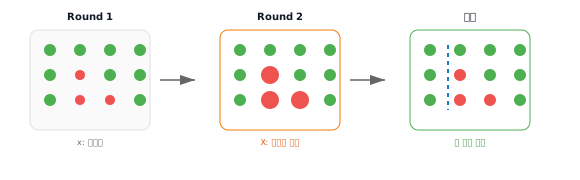
- 이전 모델이 틀린 샘플에 집중
- 순차적 학습으로 편향(Bias) 감소
Bagging vs Boosting
| 특성 | Bagging | Boosting |
|---|---|---|
| 학습 방식 | 병렬 (독립) | 순차 (의존) |
| 샘플 가중치 | 동일 | 오분류 샘플에 높음 |
| 목표 | Variance 감소 | Bias 감소 |
| 과적합 위험 | 낮음 | 있음 |
| 기반 모델 | 복잡한 모델 | 단순한 모델 (Weak Learner) |
AdaBoost (Adaptive Boosting)
알고리즘
Algorithm: AdaBoost

Input: 학습 데이터 {(x_i, y_i)}, y_i in {-1, +1}, 반복 횟수 T
Output: 최종 분류기 H(x)

# 초기화: 모든 샘플 동일 가중치
w_i = 1/n for all i

for t = 1 to T:
    # 1. 가중치 분포로 약한 학습기 학습
    h_t = train_weak_learner(X, y, w)

    # 2. 가중 오분류율 계산
    err_t = sum(w_i * I(y_i != h_t(x_i))) / sum(w_i)

    # 3. 학습기 가중치 계산
    alpha_t = 0.5 * ln((1 - err_t) / err_t)

    # 4. 샘플 가중치 업데이트
    w_i = w_i * exp(-alpha_t * y_i * h_t(x_i))

    # 5. 가중치 정규화
    w_i = w_i / sum(w)

# 최종 분류기
H(x) = sign(sum_{t=1}^{T} alpha_t * h_t(x))
핵심 수식
학습기 가중치:
\[\alpha_t = \frac{1}{2} \ln\left(\frac{1 - \epsilon_t}{\epsilon_t}\right)\]
- \(\epsilon_t < 0.5\): 양수 가중치 (정확한 분류기)
- \(\epsilon_t = 0.5\): 가중치 0 (랜덤 추측)
- \(\epsilon_t > 0.5\): 음수 가중치 (반대로 사용)
샘플 가중치 업데이트:
\[w_i^{(t+1)} = w_i^{(t)} \cdot e^{-\alpha_t y_i h_t(x_i)}\]
- 맞춘 샘플: 가중치 감소 (\(y_i h_t(x_i) = +1\))
- 틀린 샘플: 가중치 증가 (\(y_i h_t(x_i) = -1\))
시각화
scikit-learn 구현
from sklearn.ensemble import AdaBoostClassifier
from sklearn.tree import DecisionTreeClassifier
from sklearn.datasets import make_classification
from sklearn.model_selection import train_test_split, cross_val_score
import matplotlib.pyplot as plt
import numpy as np

# 데이터
X, y = make_classification(n_samples=1000, n_features=20, n_informative=10, random_state=42)
X_train, X_test, y_train, y_test = train_test_split(X, y, test_size=0.2, random_state=42)

# AdaBoost with Decision Stump
ada = AdaBoostClassifier(
    estimator=DecisionTreeClassifier(max_depth=1),  # Stump
    n_estimators=100,
    learning_rate=1.0,
    algorithm='SAMME',  # 'SAMME.R' for probability-based
    random_state=42
)

ada.fit(X_train, y_train)

print(f"Train Accuracy: {ada.score(X_train, y_train):.4f}")
print(f"Test Accuracy: {ada.score(X_test, y_test):.4f}")

# Staged prediction (각 라운드별 성능)
train_errors = []
test_errors = []

for y_pred_train, y_pred_test in zip(
    ada.staged_predict(X_train),
    ada.staged_predict(X_test)
):
    train_errors.append(1 - np.mean(y_pred_train == y_train))
    test_errors.append(1 - np.mean(y_pred_test == y_test))

plt.figure(figsize=(10, 5))
plt.plot(train_errors, label='Train Error')
plt.plot(test_errors, label='Test Error')
plt.xlabel('Number of Estimators')
plt.ylabel('Error Rate')
plt.legend()
plt.title('AdaBoost Learning Curve')
plt.savefig('adaboost_curve.png', dpi=150)
plt.show()
Gradient Boosting
핵심 아이디어
손실 함수의 기울기(Gradient) 방향으로 모델을 순차 개선
일반적인 함수 근사:
\[F(x) = \sum_{m=1}^{M} \gamma_m h_m(x)\]
각 단계에서 잔차(Residual) 를 학습:
\[r_{im} = -\left[\frac{\partial L(y_i, F(x_i))}{\partial F(x_i)}\right]_{F=F_{m-1}}\]
알고리즘
Algorithm: Gradient Boosting

Input: 학습 데이터, 손실 함수 L, 반복 횟수 M
Output: 최종 모델 F_M(x)

# 초기화
F_0(x) = argmin_c sum L(y_i, c)

for m = 1 to M:
    # 1. Pseudo-residuals 계산
    r_im = -[dL(y_i, F(x_i)) / dF(x_i)] at F=F_{m-1}

    # 2. 잔차에 대해 기반 학습기 학습
    h_m = fit_base_learner(X, r)

    # 3. 최적 step size 계산 (line search)
    gamma_m = argmin_gamma sum L(y_i, F_{m-1}(x_i) + gamma * h_m(x_i))

    # 4. 모델 업데이트
    F_m(x) = F_{m-1}(x) + learning_rate * gamma_m * h_m(x)

return F_M
손실 함수별 Pseudo-Residual
| 손실 함수 | 수식 | Pseudo-Residual |
|---|---|---|
| MSE (회귀) | \(\frac{1}{2}(y - F)^2\) | \(y - F\) (실제 잔차) |
| MAE (회귀) | $ | y - F |
| Log Loss (분류) | \(-[y\log p + (1-y)\log(1-p)]\) | \(y - p\) |
scikit-learn 구현
from sklearn.ensemble import GradientBoostingClassifier, GradientBoostingRegressor
from sklearn.datasets import load_breast_cancer, fetch_california_housing
from sklearn.model_selection import train_test_split
from sklearn.metrics import accuracy_score, mean_squared_error
import numpy as np

# === 분류 ===
X, y = load_breast_cancer(return_X_y=True)
X_train, X_test, y_train, y_test = train_test_split(X, y, test_size=0.2, random_state=42)

gb_clf = GradientBoostingClassifier(
    n_estimators=100,
    learning_rate=0.1,
    max_depth=3,
    min_samples_split=2,
    min_samples_leaf=1,
    subsample=0.8,          # Stochastic Gradient Boosting
    max_features='sqrt',
    random_state=42
)

gb_clf.fit(X_train, y_train)
print(f"GBM Classification Accuracy: {gb_clf.score(X_test, y_test):.4f}")

# === 회귀 ===
X, y = fetch_california_housing(return_X_y=True)
X, y = X[:5000], y[:5000]
X_train, X_test, y_train, y_test = train_test_split(X, y, test_size=0.2, random_state=42)

gb_reg = GradientBoostingRegressor(
    n_estimators=100,
    learning_rate=0.1,
    max_depth=4,
    subsample=0.8,
    loss='squared_error',  # 'absolute_error', 'huber', 'quantile'
    random_state=42
)

gb_reg.fit(X_train, y_train)
y_pred = gb_reg.predict(X_test)
print(f"GBM Regression RMSE: {np.sqrt(mean_squared_error(y_test, y_pred)):.4f}")
하이퍼파라미터 가이드
주요 파라미터
| 파라미터 | 설명 | 권장 범위 |
|---|---|---|
| n_estimators | 부스팅 라운드 수 | 100 ~ 1000+ |
| learning_rate | 각 트리의 기여도 | 0.01 ~ 0.3 |
| max_depth | 트리 최대 깊이 | 3 ~ 8 |
| subsample | 샘플 샘플링 비율 | 0.5 ~ 1.0 |
| min_samples_split | 분할 최소 샘플 | 2 ~ 20 |
| min_samples_leaf | 리프 최소 샘플 | 1 ~ 10 |
n_estimators vs learning_rate
두 파라미터는 트레이드오프 관계:
n_estimators * learning_rate ≈ constant (총 학습량)

- 낮은 learning_rate + 높은 n_estimators: 느리지만 안정적
- 높은 learning_rate + 낮은 n_estimators: 빠르지만 불안정
# 권장: 낮은 learning_rate, 많은 n_estimators
gb = GradientBoostingClassifier(
    n_estimators=500,
    learning_rate=0.05,
    max_depth=4
)
Early Stopping
from sklearn.model_selection import train_test_split

# 검증 세트 분리
X_train_sub, X_val, y_train_sub, y_val = train_test_split(
    X_train, y_train, test_size=0.2, random_state=42
)

gb = GradientBoostingClassifier(
    n_estimators=1000,
    learning_rate=0.05,
    max_depth=4,
    validation_fraction=0.2,
    n_iter_no_change=10,  # Early stopping patience
    tol=1e-4,
    random_state=42
)

gb.fit(X_train, y_train)
print(f"Best n_estimators: {gb.n_estimators_}")
XGBoost와 LightGBM
Gradient Boosting의 발전된 구현:
| 특성 | sklearn GBM | XGBoost | LightGBM |
|---|---|---|---|
| 속도 | 느림 | 빠름 | 가장 빠름 |
| 메모리 | 높음 | 중간 | 낮음 |
| 정규화 | 제한적 | L1, L2 | L1, L2 |
| 결측치 | 전처리 필요 | 자동 처리 | 자동 처리 |
| GPU | 미지원 | 지원 | 지원 |
| 범주형 | 인코딩 필요 | 인코딩 필요 | 직접 지원 |
AdaBoost vs Gradient Boosting
| 특성 | AdaBoost | Gradient Boosting |
|---|---|---|
| 가중치 대상 | 샘플 | 잔차 (기울기) |
| 손실 함수 | 지수 손실 고정 | 자유 선택 |
| 유연성 | 낮음 | 높음 |
| 이상치 민감도 | 높음 | 손실 함수에 따름 |
| 일반적 성능 | 보통 | 우수 |
언제 쓰나?
적합한 상황: - 테이블 데이터 (정형 데이터) - 높은 예측 성능 필요 - 특성 중요도 분석 - 대회 / 프로덕션 모델
주의 사항: - 과적합 위험 (regularization 필요) - 학습 속도 느림 (순차 학습) - 이상치에 민감할 수 있음
관련 문서
| 주제 | 링크 |
|---|---|
| 앙상블 개요 | README.md |
| Bagging | bagging.md |
| Stacking | stacking.md |
| XGBoost | ../supervised/classification/xgboost.md |
| LightGBM | ../supervised/classification/lightgbm.md |
| Random Forest | ../supervised/classification/random-forest.md |
참고
- Freund, Y. & Schapire, R.E. (1997). "A Decision-Theoretic Generalization of On-Line Learning and an Application to Boosting"
- Friedman, J.H. (2001). "Greedy Function Approximation: A Gradient Boosting Machine"
- Chen, T. & Guestrin, C. (2016). "XGBoost: A Scalable Tree Boosting System"
- scikit-learn Gradient Boosting: https://scikit-learn.org/stable/modules/ensemble.html#gradient-boosting