신경망 기초 (Neural Network Basics)
생물학적 신경망에서 영감을 받은 계산 모델. 입력을 받아 비선형 변환을 통해 출력을 생성함.
퍼셉트론 (Perceptron)
가장 단순한 신경망 단위.
구조
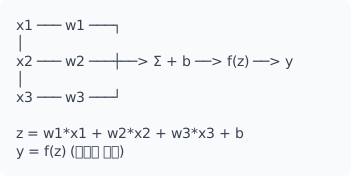
수식
\[z = \sum_{i=1}^{n} w_i x_i + b = \mathbf{w}^T \mathbf{x} + b$$
$$y = f(z)\]
import numpy as np

class Perceptron:
    def __init__(self, n_inputs):
        self.weights = np.random.randn(n_inputs) * 0.01
        self.bias = 0

    def forward(self, x):
        z = np.dot(self.weights, x) + self.bias
        return self.activation(z)

    def activation(self, z):
        return 1 if z > 0 else 0  # Step function

    def train(self, X, y, learning_rate=0.1, epochs=100):
        for _ in range(epochs):
            for xi, yi in zip(X, y):
                prediction = self.forward(xi)
                error = yi - prediction
                self.weights += learning_rate * error * xi
                self.bias += learning_rate * error
한계: XOR 문제
단층 퍼셉트론은 선형 분리 가능한 문제만 해결.
다층 퍼셉트론 (MLP)
여러 층을 쌓아 비선형 문제 해결.
구조
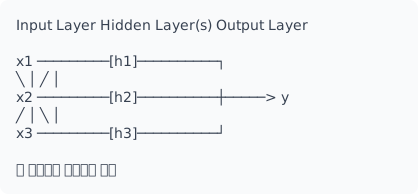
수식
Layer \(l\)의 출력: $\(\mathbf{z}^{(l)} = \mathbf{W}^{(l)} \mathbf{a}^{(l-1)} + \mathbf{b}^{(l)}\)$ $\(\mathbf{a}^{(l)} = f(\mathbf{z}^{(l)})\)$
import torch
import torch.nn as nn

class MLP(nn.Module):
    def __init__(self, input_dim, hidden_dims, output_dim):
        super().__init__()

        layers = []
        prev_dim = input_dim

        for hidden_dim in hidden_dims:
            layers.append(nn.Linear(prev_dim, hidden_dim))
            layers.append(nn.ReLU())
            prev_dim = hidden_dim

        layers.append(nn.Linear(prev_dim, output_dim))

        self.network = nn.Sequential(*layers)

    def forward(self, x):
        return self.network(x)

# 사용
model = MLP(input_dim=784, hidden_dims=[256, 128], output_dim=10)
output = model(torch.randn(32, 784))  # (batch_size, input_dim)
XOR 문제 해결
# XOR 데이터
X = torch.tensor([[0, 0], [0, 1], [1, 0], [1, 1]], dtype=torch.float32)
y = torch.tensor([[0], [1], [1], [0]], dtype=torch.float32)

# 2층 MLP
model = nn.Sequential(
    nn.Linear(2, 4),
    nn.ReLU(),
    nn.Linear(4, 1),
    nn.Sigmoid()
)

criterion = nn.BCELoss()
optimizer = torch.optim.Adam(model.parameters(), lr=0.1)

for epoch in range(1000):
    output = model(X)
    loss = criterion(output, y)
    optimizer.zero_grad()
    loss.backward()
    optimizer.step()

print(model(X).round())  # [[0], [1], [1], [0]]
순전파 (Forward Propagation)
입력에서 출력까지 순차적으로 계산.
계산 과정
def forward_pass(X, weights, biases, activation_fn):
    """
    X: 입력 (batch_size, input_dim)
    weights: 각 층의 가중치 리스트
    biases: 각 층의 편향 리스트
    """
    activations = [X]

    for i, (W, b) in enumerate(zip(weights, biases)):
        z = activations[-1] @ W + b  # 선형 변환

        if i < len(weights) - 1:
            a = activation_fn(z)  # 은닉층: 활성화 적용
        else:
            a = z  # 출력층: 활성화 없음 (또는 Softmax)

        activations.append(a)

    return activations

# 예시
X = np.random.randn(32, 784)  # 배치
W1 = np.random.randn(784, 256) * 0.01
b1 = np.zeros(256)
W2 = np.random.randn(256, 10) * 0.01
b2 = np.zeros(10)

activations = forward_pass(X, [W1, W2], [b1, b2], lambda x: np.maximum(0, x))
output = activations[-1]  # (32, 10)
벡터화 연산
# 개별 샘플 처리 (느림)
for i in range(batch_size):
    z = np.dot(W, X[i]) + b

# 벡터화 (빠름)
Z = X @ W + b  # 행렬 곱셈
Universal Approximation Theorem
충분히 넓은 단일 은닉층 MLP는 임의의 연속 함수를 근사할 수 있음.
신경망 구성 요소
층의 종류
| 층 | 설명 | 사용 |
|---|---|---|
| Linear (Dense) | 완전 연결 | MLP, 출력층 |
| Conv | 합성곱 | 이미지, 시퀀스 |
| RNN/LSTM | 순환 | 시퀀스 |
| Attention | 어텐션 | Transformer |
| Embedding | 임베딩 | 범주형, 텍스트 |
PyTorch 층 예시
import torch.nn as nn

# 완전 연결층
linear = nn.Linear(in_features=256, out_features=128)

# 합성곱층
conv = nn.Conv2d(in_channels=3, out_channels=64, kernel_size=3, padding=1)

# LSTM
lstm = nn.LSTM(input_size=256, hidden_size=512, num_layers=2, batch_first=True)

# 임베딩층
embedding = nn.Embedding(num_embeddings=50000, embedding_dim=768)

# 어텐션 (Transformer)
attention = nn.MultiheadAttention(embed_dim=512, num_heads=8)
가중치 초기화
초기화 방법
| 방법 | 수식 | 활성화 함수 |
|---|---|---|
| Xavier/Glorot | \(\mathcal{U}(-\sqrt{6/(n_{in}+n_{out})}, \sqrt{6/(n_{in}+n_{out})})\) | Sigmoid, Tanh |
| He/Kaiming | \(\mathcal{N}(0, \sqrt{2/n_{in}})\) | ReLU |
| LeCun | \(\mathcal{N}(0, \sqrt{1/n_{in}})\) | SELU |
# PyTorch 초기화
def init_weights(module):
    if isinstance(module, nn.Linear):
        # He 초기화 (ReLU용)
        nn.init.kaiming_normal_(module.weight, nonlinearity='relu')
        if module.bias is not None:
            nn.init.zeros_(module.bias)

    elif isinstance(module, nn.Embedding):
        nn.init.normal_(module.weight, mean=0, std=0.02)

model.apply(init_weights)

# 또는 직접
nn.init.xavier_uniform_(layer.weight)
nn.init.zeros_(layer.bias)
초기화가 중요한 이유
너무 작은 초기화:
- 기울기 소실
- 모든 층의 출력이 0에 수렴

너무 큰 초기화:
- 기울기 폭발
- 학습 불안정

적절한 초기화:
- 분산이 층을 지나도 유지
- 안정적인 학습
파라미터 수 계산
def count_parameters(model):
    """모델의 학습 가능한 파라미터 수 계산"""
    return sum(p.numel() for p in model.parameters() if p.requires_grad)

# Linear(784, 256): 784 * 256 + 256 = 200,960
# Linear(256, 10): 256 * 10 + 10 = 2,570
# 총: 203,530

model = MLP(784, [256], 10)
print(f"Parameters: {count_parameters(model):,}")
신경망 설계 원칙
깊이 vs 너비
병목 구조
# 병목 블록 (ResNet)
class Bottleneck(nn.Module):
    def __init__(self, in_channels, out_channels):
        super().__init__()
        mid = out_channels // 4

        self.conv1 = nn.Conv2d(in_channels, mid, 1)
        self.conv2 = nn.Conv2d(mid, mid, 3, padding=1)
        self.conv3 = nn.Conv2d(mid, out_channels, 1)
        self.relu = nn.ReLU()

    def forward(self, x):
        out = self.relu(self.conv1(x))
        out = self.relu(self.conv2(out))
        out = self.conv3(out)
        return self.relu(out + x)  # Residual connection
CNN (Convolutional Neural Network)
이미지, 시퀀스 등 공간적/시간적 구조를 가진 데이터에 특화된 아키텍처.
핵심 아이디어
1. 지역적 연결 (Local Connectivity)
   - 모든 픽셀이 아닌 인접 픽셀끼리만 연결
   - 파라미터 수 대폭 감소

2. 가중치 공유 (Weight Sharing)
   - 동일한 필터를 이미지 전체에 적용
   - 위치 불변 특징 추출

3. 계층적 특징 학습
   - 초기 층: 엣지, 색상
   - 중간 층: 텍스처, 패턴
   - 후기 층: 객체 부분, 의미적 특징
기본 연산
import torch.nn as nn

# 합성곱 층
conv = nn.Conv2d(
    in_channels=3,      # 입력 채널 (RGB)
    out_channels=64,    # 출력 채널 (필터 수)
    kernel_size=3,      # 필터 크기
    stride=1,           # 이동 간격
    padding=1           # 패딩 (same padding)
)

# 출력 크기 계산
# H_out = (H_in + 2*padding - kernel_size) / stride + 1

# 풀링 층 (다운샘플링)
maxpool = nn.MaxPool2d(kernel_size=2, stride=2)
avgpool = nn.AvgPool2d(kernel_size=2, stride=2)
adaptive_pool = nn.AdaptiveAvgPool2d((1, 1))  # Global Average Pooling
간단한 CNN
class SimpleCNN(nn.Module):
    def __init__(self, num_classes=10):
        super().__init__()

        self.features = nn.Sequential(
            # Conv Block 1
            nn.Conv2d(3, 32, kernel_size=3, padding=1),
            nn.BatchNorm2d(32),
            nn.ReLU(),
            nn.MaxPool2d(2),

            # Conv Block 2
            nn.Conv2d(32, 64, kernel_size=3, padding=1),
            nn.BatchNorm2d(64),
            nn.ReLU(),
            nn.MaxPool2d(2),

            # Conv Block 3
            nn.Conv2d(64, 128, kernel_size=3, padding=1),
            nn.BatchNorm2d(128),
            nn.ReLU(),
            nn.AdaptiveAvgPool2d((1, 1))
        )

        self.classifier = nn.Linear(128, num_classes)

    def forward(self, x):
        x = self.features(x)
        x = x.view(x.size(0), -1)  # Flatten
        x = self.classifier(x)
        return x

# 입력: (batch, 3, 32, 32) -> 출력: (batch, 10)
model = SimpleCNN()
output = model(torch.randn(16, 3, 32, 32))
RNN (Recurrent Neural Network)
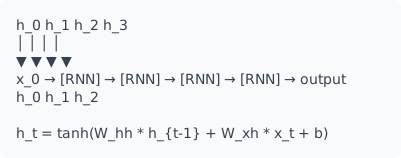
시퀀스 데이터를 처리하기 위한 아키텍처. 이전 시점의 정보를 현재 시점에 전달.
기본 구조
구현
# 기본 RNN
rnn = nn.RNN(
    input_size=256,     # 입력 특징 차원
    hidden_size=512,    # 은닉 상태 차원
    num_layers=2,       # RNN 층 수
    batch_first=True,   # (batch, seq, feature) 형태
    dropout=0.1,        # 층 간 드롭아웃
    bidirectional=True  # 양방향
)

# LSTM (Long Short-Term Memory)
# 장기 의존성 학습, 기울기 소실 완화
lstm = nn.LSTM(
    input_size=256,
    hidden_size=512,
    num_layers=2,
    batch_first=True,
    bidirectional=True
)

# GRU (Gated Recurrent Unit)
# LSTM 간소화 버전, 비슷한 성능
gru = nn.GRU(
    input_size=256,
    hidden_size=512,
    num_layers=2,
    batch_first=True
)

# 사용
x = torch.randn(32, 100, 256)  # (batch, seq_len, input_size)
output, hidden = rnn(x)        # output: (32, 100, 1024) - bidirectional
시퀀스 분류
class TextClassifier(nn.Module):
    def __init__(self, vocab_size, embed_dim, hidden_dim, num_classes):
        super().__init__()
        self.embedding = nn.Embedding(vocab_size, embed_dim)
        self.lstm = nn.LSTM(embed_dim, hidden_dim, batch_first=True, bidirectional=True)
        self.classifier = nn.Linear(hidden_dim * 2, num_classes)

    def forward(self, x):
        embedded = self.embedding(x)           # (batch, seq, embed)
        output, (hidden, cell) = self.lstm(embedded)

        # 마지막 은닉 상태 사용
        hidden = torch.cat([hidden[-2], hidden[-1]], dim=-1)  # 양방향 결합
        logits = self.classifier(hidden)
        return logits
실무 사용 가이드
아키텍처 선택 기준
| 데이터 | 권장 아키텍처 | 이유 |
|---|---|---|
| 이미지 분류 | CNN (ResNet, EfficientNet) | 공간적 불변성 |
| 시계열 예측 | LSTM, Transformer | 시간적 의존성 |
| 텍스트 분류 | Transformer (BERT) | 장거리 의존성 |
| 표 형태 데이터 | MLP, Gradient Boosting | 구조가 단순 |
모델 크기 결정
def estimate_model_size(model, input_size=(1, 3, 224, 224)):
    """모델 크기 및 연산량 추정"""
    from torchinfo import summary

    info = summary(model, input_size=input_size, verbose=0)

    params_mb = info.total_params * 4 / (1024 ** 2)  # float32 기준

    print(f"파라미터 수: {info.total_params:,}")
    print(f"모델 크기: {params_mb:.2f} MB")
    print(f"예상 MACs: {info.total_mult_adds:,}")

    return info

# 메모리 제약 시 고려사항:
# - 작은 은닉 차원
# - 더 적은 층
# - 효율적 아키텍처 (MobileNet, EfficientNet)
디버깅 가이드
일반적인 문제와 해결책
| 문제 | 증상 | 해결책 |
|---|---|---|
| 학습 안 됨 | Loss가 감소 안 함 | LR 조정, 초기화 확인 |
| 기울기 소실 | 깊은 층 기울기≈0 | ReLU, ResNet, 초기화 |
| 기울기 폭발 | Loss=NaN, Inf | Gradient Clipping, LR↓ |
| 과적합 | Train↓, Val↑ | Dropout, Data Aug |
| 과소적합 | Train↓ 안 됨 | 모델 용량↑, LR↑ |
디버깅 체크리스트
def debug_training(model, train_loader, criterion, optimizer):
    """학습 디버깅 체크리스트"""

    # 1. 단일 배치 과적합 테스트
    print("=== 단일 배치 과적합 테스트 ===")
    x, y = next(iter(train_loader))

    for i in range(100):
        optimizer.zero_grad()
        output = model(x)
        loss = criterion(output, y)
        loss.backward()
        optimizer.step()

        if i % 20 == 0:
            print(f"Step {i}: Loss = {loss.item():.4f}")

    if loss.item() > 0.1:
        print("[WARNING] 단일 배치도 과적합 못함 - 모델 구조 또는 LR 확인")

    # 2. 기울기 체크
    print("\n=== 기울기 통계 ===")
    for name, param in model.named_parameters():
        if param.grad is not None:
            grad = param.grad
            print(f"{name}: grad_mean={grad.mean():.6f}, grad_std={grad.std():.6f}, "
                  f"grad_max={grad.max():.6f}")

    # 3. 활성화 체크
    print("\n=== 활성화 통계 ===")
    activations = {}

    def hook_fn(name):
        def hook(module, input, output):
            activations[name] = output.detach()
        return hook

    hooks = []
    for name, module in model.named_modules():
        if isinstance(module, (nn.ReLU, nn.GELU)):
            hooks.append(module.register_forward_hook(hook_fn(name)))

    with torch.no_grad():
        _ = model(x)

    for name, act in activations.items():
        dead_pct = 100 * (act == 0).float().mean()
        print(f"{name}: dead_neurons={dead_pct:.1f}%")
        if dead_pct > 50:
            print(f"  [WARNING] 죽은 뉴런 비율 높음!")

    for h in hooks:
        h.remove()

# 사용
debug_training(model, train_loader, criterion, optimizer)
Loss가 감소하지 않을 때
# 1. Learning Rate 확인
# 너무 크면: 진동, 발산
# 너무 작으면: 매우 느린 수렴

# LR Range Test
from torch_lr_finder import LRFinder

lr_finder = LRFinder(model, optimizer, criterion)
lr_finder.range_test(train_loader, end_lr=10, num_iter=100)
lr_finder.plot()  # 가파르게 감소하는 지점의 1/10 사용

# 2. 데이터 확인
print("데이터 샘플 확인:")
x, y = next(iter(train_loader))
print(f"X shape: {x.shape}, dtype: {x.dtype}")
print(f"Y shape: {y.shape}, dtype: {y.dtype}")
print(f"X range: [{x.min():.2f}, {x.max():.2f}]")
print(f"Y unique: {torch.unique(y)}")

# 3. 모델 출력 확인
with torch.no_grad():
    output = model(x)
print(f"Output shape: {output.shape}")
print(f"Output range: [{output.min():.2f}, {output.max():.2f}]")
NaN/Inf 발생 시
# NaN 감지 훅
def nan_hook(module, input, output):
    if torch.isnan(output).any():
        print(f"NaN detected in {module.__class__.__name__}")
        print(f"Input stats: mean={input[0].mean()}, std={input[0].std()}")
        raise RuntimeError("NaN detected!")

for module in model.modules():
    module.register_forward_hook(nan_hook)

# 일반적인 원인과 해결:
# 1. 학습률이 너무 높음 → LR 낮추기
# 2. 로그에 0 입력 → log(x + eps)
# 3. 나눗셈 문제 → 분모에 eps 추가
# 4. 초기화 문제 → Xavier/He 초기화