모델 모니터링 (Drift Detection)
프로덕션 ML 모델의 성능을 지속적으로 모니터링하고, 데이터 드리프트와 모델 성능 저하를 감지하여 적시에 대응함.
1. 모니터링이 필요한 이유
1.1 ML 시스템 실패 모드
| 실패 유형 | 원인 | 증상 |
|---|---|---|
| 데이터 드리프트 | 입력 분포 변화 | 특성 통계 변화 |
| 컨셉 드리프트 | 입력-출력 관계 변화 | 동일 입력, 다른 정답 |
| 모델 성능 저하 | 위 두 가지 결과 | 정확도/F1 감소 |
| 데이터 품질 문제 | ETL 오류, 스키마 변경 | 결측값, 이상치 급증 |
| 시스템 장애 | 인프라 문제 | 지연 시간 증가, 오류율 증가 |
1.2 모니터링 레이어
+------------------+
|    Business KPIs  |   (매출, 전환율, 클릭률)
+------------------+
         |
+------------------+
|   Model Metrics   |   (Accuracy, F1, AUC, RMSE)
+------------------+
         |
+------------------+
|   Data Quality    |   (결측값, 이상치, 스키마)
+------------------+
         |
+------------------+
|   Data Drift      |   (분포 변화, 통계 변화)
+------------------+
         |
+------------------+
|   System Metrics  |   (Latency, Throughput, Errors)
+------------------+
2. 데이터 드리프트 (Data Drift)
2.1 드리프트 유형
1. Covariate Shift (입력 분포 변화)
   - P(X)가 변화, P(Y|X)는 동일
   - 예: 새로운 사용자층 유입

2. Prior Probability Shift (레이블 분포 변화)
   - P(Y)가 변화
   - 예: 계절적 수요 변화

3. Concept Drift (관계 변화)
   - P(Y|X)가 변화
   - 예: 사용자 선호도 변화

4. Upstream Data Change
   - 데이터 파이프라인 변경
   - 예: 로깅 형식 변경
2.2 드리프트 감지 방법
통계적 검정
| 방법 | 대상 | 특징 |
|---|---|---|
| KS Test | 연속형 | 분포 형태 비교 |
| Chi-Square Test | 범주형 | 빈도 분포 비교 |
| PSI (Population Stability Index) | 둘 다 | 점수 기반, 해석 용이 |
| Wasserstein Distance | 연속형 | Earth Mover's Distance |
| Jensen-Shannon Divergence | 둘 다 | 분포 간 거리 |
PSI 계산
import numpy as np

def calculate_psi(reference, current, bins=10):
    """
    Population Stability Index 계산
    PSI < 0.1: 변화 없음
    0.1 <= PSI < 0.2: 약간의 변화
    PSI >= 0.2: 유의미한 변화
    """
    # 동일한 구간으로 나눔
    breakpoints = np.percentile(reference, np.linspace(0, 100, bins + 1))
    breakpoints[0] = -np.inf
    breakpoints[-1] = np.inf

    # 각 구간의 비율 계산
    ref_counts = np.histogram(reference, breakpoints)[0] / len(reference)
    cur_counts = np.histogram(current, breakpoints)[0] / len(current)

    # 0 방지
    ref_counts = np.clip(ref_counts, 0.0001, None)
    cur_counts = np.clip(cur_counts, 0.0001, None)

    # PSI 계산
    psi = np.sum((cur_counts - ref_counts) * np.log(cur_counts / ref_counts))

    return psi
KS Test
from scipy import stats

def ks_test_drift(reference, current, threshold=0.05):
    """
    Kolmogorov-Smirnov 검정
    p-value < threshold이면 드리프트 감지
    """
    statistic, p_value = stats.ks_2samp(reference, current)

    return {
        'statistic': statistic,
        'p_value': p_value,
        'drift_detected': p_value < threshold
    }
3. Evidently AI
3.1 설치 및 기본 사용
# pip install evidently

from evidently import ColumnMapping
from evidently.report import Report
from evidently.metric_preset import DataDriftPreset, DataQualityPreset
from evidently.metrics import *

import pandas as pd

# 데이터 준비
reference_data = pd.read_csv("data/reference.csv")  # 학습 데이터 또는 초기 데이터
current_data = pd.read_csv("data/current.csv")      # 프로덕션 데이터

# 컬럼 매핑
column_mapping = ColumnMapping(
    target="target",
    prediction="prediction",
    numerical_features=["feature1", "feature2", "feature3"],
    categorical_features=["category1", "category2"],
)

# 데이터 드리프트 리포트
report = Report(metrics=[
    DataDriftPreset(),
])

report.run(
    reference_data=reference_data,
    current_data=current_data,
    column_mapping=column_mapping,
)

# HTML 저장
report.save_html("data_drift_report.html")

# Dictionary 변환
result = report.as_dict()
3.2 데이터 품질 리포트
from evidently.metric_preset import DataQualityPreset

quality_report = Report(metrics=[
    DataQualityPreset(),
])

quality_report.run(
    reference_data=reference_data,
    current_data=current_data,
    column_mapping=column_mapping,
)

# 결과 확인
quality_dict = quality_report.as_dict()
3.3 모델 성능 리포트
from evidently.metric_preset import ClassificationPreset, RegressionPreset

# 분류 모델
classification_report = Report(metrics=[
    ClassificationPreset(),
])

classification_report.run(
    reference_data=reference_data,
    current_data=current_data,
    column_mapping=column_mapping,
)

# 회귀 모델
regression_report = Report(metrics=[
    RegressionPreset(),
])
3.4 커스텀 메트릭
from evidently.metrics import (
    DatasetDriftMetric,
    DataDriftTable,
    ColumnDriftMetric,
    DatasetMissingValuesMetric,
    ColumnQuantileMetric,
)

custom_report = Report(metrics=[
    # 데이터셋 전체 드리프트
    DatasetDriftMetric(),

    # 개별 컬럼 드리프트 테이블
    DataDriftTable(),

    # 특정 컬럼 드리프트
    ColumnDriftMetric(column_name="feature1"),
    ColumnDriftMetric(column_name="category1"),

    # 결측값 비율
    DatasetMissingValuesMetric(),

    # 분위수 모니터링
    ColumnQuantileMetric(column_name="feature1", quantile=0.5),
    ColumnQuantileMetric(column_name="feature1", quantile=0.95),
])
3.5 Test Suite (자동화된 검증)
from evidently.test_suite import TestSuite
from evidently.test_preset import DataDriftTestPreset, DataQualityTestPreset
from evidently.tests import *

# 테스트 스위트 정의
test_suite = TestSuite(tests=[
    # 프리셋
    DataDriftTestPreset(),
    DataQualityTestPreset(),

    # 개별 테스트
    TestNumberOfRows(gte=1000),  # 최소 1000행
    TestNumberOfColumns(eq=10),  # 정확히 10개 컬럼
    TestShareOfMissingValues(lte=0.05),  # 결측값 5% 이하
    TestColumnDrift(column_name="feature1"),
])

test_suite.run(
    reference_data=reference_data,
    current_data=current_data,
    column_mapping=column_mapping,
)

# 결과 확인
result = test_suite.as_dict()
all_passed = result["summary"]["all_passed"]

if not all_passed:
    failed_tests = [t for t in result["tests"] if t["status"] == "FAIL"]
    print(f"Failed tests: {len(failed_tests)}")
    for test in failed_tests:
        print(f"  - {test['name']}: {test['description']}")
4. 프로덕션 모니터링 파이프라인
4.1 Airflow DAG
from airflow import DAG
from airflow.operators.python import PythonOperator
from datetime import datetime, timedelta
import pandas as pd
from evidently.report import Report
from evidently.metric_preset import DataDriftPreset
from evidently.test_suite import TestSuite
from evidently.test_preset import DataDriftTestPreset

def load_reference_data():
    """학습 데이터 또는 기준 데이터 로드"""
    return pd.read_parquet("s3://bucket/reference/data.parquet")

def load_production_data(**context):
    """최근 프로덕션 데이터 로드"""
    execution_date = context["execution_date"]
    date_str = execution_date.strftime("%Y-%m-%d")
    return pd.read_parquet(f"s3://bucket/production/{date_str}/data.parquet")

def run_drift_tests(**context):
    """드리프트 테스트 실행"""
    reference = load_reference_data()
    current = load_production_data(**context)

    test_suite = TestSuite(tests=[DataDriftTestPreset()])
    test_suite.run(reference_data=reference, current_data=current)

    result = test_suite.as_dict()

    if not result["summary"]["all_passed"]:
        # 알림 전송
        send_alert("Data drift detected!", result)

    return result["summary"]["all_passed"]

def generate_monitoring_report(**context):
    """모니터링 리포트 생성"""
    reference = load_reference_data()
    current = load_production_data(**context)

    report = Report(metrics=[DataDriftPreset()])
    report.run(reference_data=reference, current_data=current)

    # S3에 저장
    date_str = context["execution_date"].strftime("%Y-%m-%d")
    report.save_html(f"s3://bucket/reports/{date_str}/drift_report.html")

def send_alert(message, details):
    """Slack/Email 알림"""
    import requests

    requests.post(
        "https://hooks.slack.com/services/...",
        json={
            "text": f":warning: {message}",
            "attachments": [{"text": str(details)}]
        }
    )

with DAG(
    dag_id="model_monitoring",
    schedule_interval="@daily",
    start_date=datetime(2024, 1, 1),
    catchup=False,
    default_args={
        "retries": 3,
        "retry_delay": timedelta(minutes=5),
    },
) as dag:

    drift_test = PythonOperator(
        task_id="run_drift_tests",
        python_callable=run_drift_tests,
    )

    report = PythonOperator(
        task_id="generate_report",
        python_callable=generate_monitoring_report,
    )

    drift_test >> report
4.2 실시간 모니터링 (FastAPI + Prometheus)
from fastapi import FastAPI
from prometheus_client import Counter, Histogram, Gauge, generate_latest
from prometheus_client import CONTENT_TYPE_LATEST
from starlette.responses import Response
import numpy as np
from collections import deque

app = FastAPI()

# Prometheus 메트릭 정의
PREDICTION_COUNTER = Counter(
    "model_predictions_total",
    "Total number of predictions",
    ["model_name", "model_version"]
)

PREDICTION_LATENCY = Histogram(
    "model_prediction_latency_seconds",
    "Prediction latency",
    ["model_name"],
    buckets=[0.01, 0.05, 0.1, 0.25, 0.5, 1.0, 2.5, 5.0]
)

FEATURE_VALUE = Gauge(
    "model_feature_value",
    "Feature value distribution",
    ["feature_name", "stat"]  # stat: mean, std, min, max
)

PREDICTION_SCORE = Histogram(
    "model_prediction_score",
    "Prediction score distribution",
    ["model_name"],
    buckets=[0.1, 0.2, 0.3, 0.4, 0.5, 0.6, 0.7, 0.8, 0.9, 1.0]
)

# 최근 예측 저장 (드리프트 감지용)
recent_predictions = deque(maxlen=10000)
recent_features = {f"feature_{i}": deque(maxlen=10000) for i in range(5)}

@app.post("/predict")
async def predict(request: PredictionRequest):
    import time

    start = time.time()

    # 특성 저장
    for i, value in enumerate(request.features):
        recent_features[f"feature_{i}"].append(value)

    # 예측
    prediction = model.predict([request.features])[0]

    # 메트릭 기록
    latency = time.time() - start
    PREDICTION_COUNTER.labels(model_name="main", model_version="v1").inc()
    PREDICTION_LATENCY.labels(model_name="main").observe(latency)
    PREDICTION_SCORE.labels(model_name="main").observe(prediction)

    # 특성 통계 업데이트
    for name, values in recent_features.items():
        if len(values) >= 100:
            arr = np.array(list(values))
            FEATURE_VALUE.labels(feature_name=name, stat="mean").set(np.mean(arr))
            FEATURE_VALUE.labels(feature_name=name, stat="std").set(np.std(arr))

    recent_predictions.append(prediction)

    return {"prediction": prediction, "latency_ms": latency * 1000}

@app.get("/metrics")
async def metrics():
    return Response(generate_latest(), media_type=CONTENT_TYPE_LATEST)

@app.get("/drift/status")
async def drift_status():
    """간단한 드리프트 상태 확인"""
    if len(recent_predictions) < 1000:
        return {"status": "insufficient_data"}

    # 예측값 분포 확인
    recent_mean = np.mean(list(recent_predictions))
    reference_mean = 0.5  # 학습 시 평균

    drift_score = abs(recent_mean - reference_mean)

    return {
        "status": "drift_detected" if drift_score > 0.1 else "normal",
        "drift_score": drift_score,
        "recent_mean": recent_mean,
        "reference_mean": reference_mean,
    }
4.3 Grafana Dashboard
# Prometheus 알림 규칙
groups:
  - name: ml_model_alerts
    rules:
      - alert: ModelLatencyHigh
        expr: histogram_quantile(0.95, rate(model_prediction_latency_seconds_bucket[5m])) > 1
        for: 5m
        labels:
          severity: warning
        annotations:
          summary: "Model prediction latency is high"
          description: "P95 latency is {{ $value }}s"

      - alert: PredictionDrift
        expr: |
          abs(
            avg_over_time(model_prediction_score_sum[1h] / model_prediction_score_count[1h])
            - avg_over_time(model_prediction_score_sum[24h] / model_prediction_score_count[24h])
          ) > 0.1
        for: 15m
        labels:
          severity: warning
        annotations:
          summary: "Prediction score distribution drift detected"

      - alert: FeatureDrift
        expr: |
          abs(
            model_feature_value{stat="mean"} - model_feature_reference_mean
          ) / model_feature_reference_std > 2
        for: 30m
        labels:
          severity: warning
        annotations:
          summary: "Feature {{ $labels.feature_name }} drift detected"
5. 모니터링 전략
5.1 단계별 접근
Phase 1: 기본 시스템 메트릭
- Latency, Throughput, Error Rate
- 구현: Prometheus + Grafana

Phase 2: 모델 성능 메트릭
- Ground Truth 수집 후 정확도 계산
- 구현: 배치 평가 파이프라인

Phase 3: 데이터 품질 모니터링
- 결측값, 이상치, 스키마 검증
- 구현: Great Expectations, Evidently

Phase 4: 드리프트 감지
- 통계적 테스트 자동화
- 구현: Evidently Test Suite

Phase 5: 자동 대응
- 드리프트 감지 시 자동 재학습
- 구현: Airflow + MLflow
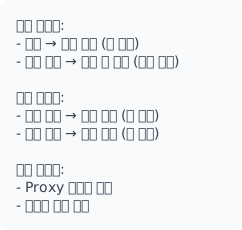
5.2 Ground Truth 수집 전략
5.3 임계값 설정 가이드
| 메트릭 | 경고 | 위험 |
|---|---|---|
| PSI | 0.1 | 0.2 |
| KS Statistic | 0.1 | 0.2 |
| 결측값 비율 | 5% 증가 | 10% 증가 |
| 정확도 저하 | 2% | 5% |
| 지연 시간 증가 | 50% | 100% |
6. 실무 케이스 스터디
6.1 케이스 1: 추천 시스템 드리프트 감지
상황: 이커머스 추천 시스템의 클릭률(CTR)이 점진적으로 하락
# 실제 모니터링 대시보드 설정
from evidently.report import Report
from evidently.metrics import (
    ColumnDriftMetric,
    DatasetDriftMetric,
    ColumnQuantileMetric,
)
import pandas as pd
from datetime import datetime, timedelta

def daily_drift_check():
    """일일 드리프트 체크"""

    # 기준 데이터 (학습 시점 또는 지난 주)
    reference = pd.read_parquet("s3://data/reference/user_features.parquet")

    # 오늘 데이터
    today = datetime.now().strftime("%Y-%m-%d")
    current = pd.read_parquet(f"s3://data/production/{today}/user_features.parquet")

    # 중요 특성에 대한 드리프트 체크
    critical_features = [
        "user_purchase_count_30d",
        "avg_session_duration",
        "category_preference_score",
    ]

    report = Report(metrics=[
        DatasetDriftMetric(),
        *[ColumnDriftMetric(column_name=f) for f in critical_features],
        *[ColumnQuantileMetric(column_name=f, quantile=0.95) for f in critical_features],
    ])

    report.run(reference_data=reference, current_data=current)
    result = report.as_dict()

    # 드리프트 감지 시 알림
    drift_detected = result["metrics"][0]["result"]["dataset_drift"]

    if drift_detected:
        drifted_features = [
            f["column_name"]
            for f in result["metrics"][1:len(critical_features)+1]
            if f["result"]["drift_detected"]
        ]

        send_slack_alert(
            channel="#ml-alerts",
            message=f"Drift detected in features: {drifted_features}",
            severity="warning"
        )

        # 자동 재학습 트리거 (선택적)
        if len(drifted_features) > 2:
            trigger_retraining_pipeline()

    return result

# 조사 결과: 신규 마케팅 캠페인으로 새로운 사용자층 유입
# 해결: 새로운 사용자 세그먼트 포함하여 모델 재학습
6.2 케이스 2: 사기 탐지 모델 성능 저하
상황: 사기 탐지 모델의 precision 급격히 하락, false positive 증가
# 레이블 드리프트 감지
from evidently.metrics import ClassificationQualityMetric
from evidently.test_suite import TestSuite
from evidently.tests import TestPrecisionScore, TestRecallScore

def fraud_model_monitoring():
    """사기 탐지 모델 모니터링"""

    # 최근 레이블 확보된 데이터
    labeled_data = get_recent_labeled_predictions(days=7)

    # 기준 기간 (안정 시점)
    baseline_data = get_baseline_labeled_data()

    # 성능 테스트
    test_suite = TestSuite(tests=[
        TestPrecisionScore(gte=0.85),   # Precision >= 85%
        TestRecallScore(gte=0.90),      # Recall >= 90%
    ])

    test_suite.run(reference_data=baseline_data, current_data=labeled_data)

    result = test_suite.as_dict()

    if not result["summary"]["all_passed"]:
        # 실패한 테스트 분석
        for test in result["tests"]:
            if test["status"] == "FAIL":
                analyze_failure(test)

    return result

def analyze_failure(test_result):
    """실패 원인 분석"""

    # 특성별 중요도 vs 드리프트 상관관계 분석
    feature_importance = get_model_feature_importance()
    feature_drift = get_feature_drift_scores()

    # 높은 중요도 + 높은 드리프트 = 주요 원인
    analysis = pd.DataFrame({
        "feature": feature_importance.keys(),
        "importance": feature_importance.values(),
        "drift_score": [feature_drift.get(f, 0) for f in feature_importance.keys()],
    })

    analysis["impact_score"] = analysis["importance"] * analysis["drift_score"]
    top_causes = analysis.nlargest(5, "impact_score")

    print("Top causes of model degradation:")
    print(top_causes)

    return top_causes

# 조사 결과: 새로운 사기 패턴 등장 (Concept Drift)
# 해결:
# 1. 새로운 사기 패턴 샘플 레이블링
# 2. 규칙 기반 필터 추가 (임시)
# 3. 모델 재학습 및 배포
6.3 케이스 3: 배포 후 지연시간 급증
상황: 모델 업데이트 후 P99 지연시간 3배 증가
# 시스템 메트릭과 모델 메트릭 통합 모니터링
import prometheus_client
from prometheus_client import Histogram, Counter, Gauge

# 메트릭 정의
PREDICTION_LATENCY = Histogram(
    "model_prediction_latency_seconds",
    "Prediction latency in seconds",
    ["model_version", "batch_size_bucket"],
    buckets=[0.01, 0.025, 0.05, 0.1, 0.25, 0.5, 1.0, 2.5]
)

INPUT_SIZE = Histogram(
    "model_input_size",
    "Size of input features",
    ["feature_type"],
    buckets=[10, 50, 100, 500, 1000, 5000]
)

def monitor_prediction(func):
    """예측 함수 데코레이터"""
    def wrapper(input_data, model_version):
        # 입력 크기 기록
        INPUT_SIZE.labels(feature_type="numeric").observe(len(input_data))

        # 배치 크기 버킷
        batch_bucket = "small" if len(input_data) < 10 else "medium" if len(input_data) < 100 else "large"

        # 예측 시간 측정
        with PREDICTION_LATENCY.labels(
            model_version=model_version,
            batch_size_bucket=batch_bucket
        ).time():
            result = func(input_data, model_version)

        return result
    return wrapper

# 분석 쿼리 (Prometheus)
"""
# P99 지연시간
histogram_quantile(0.99, rate(model_prediction_latency_seconds_bucket[5m]))

# 배치 크기별 지연시간
histogram_quantile(0.95,
    rate(model_prediction_latency_seconds_bucket{batch_size_bucket="large"}[5m])
)
"""

# 조사 결과: 새 모델의 특성 전처리 복잡도 증가
# 해결:
# 1. 특성 전처리 병렬화
# 2. 무거운 변환은 오프라인으로 이동
# 3. 모델 양자화 적용
6.4 알림 전략
# alerting_rules.yaml
groups:
  - name: ml_model_alerts
    rules:
      # 급격한 성능 저하
      - alert: ModelPerformanceDegradation
        expr: |
          (
            avg_over_time(model_accuracy[1h])
            - avg_over_time(model_accuracy[24h])
          ) / avg_over_time(model_accuracy[24h]) < -0.05
        for: 30m
        labels:
          severity: critical
          team: ml-platform
        annotations:
          summary: "Model accuracy dropped more than 5%"
          runbook: "https://wiki/ml-runbooks/performance-degradation"

      # 점진적 드리프트
      - alert: GradualDataDrift
        expr: |
          avg_over_time(feature_psi_score[7d]) > 0.15
        for: 1d
        labels:
          severity: warning
          team: data-science
        annotations:
          summary: "Gradual data drift detected over past week"

      # 예측 분포 이상
      - alert: PredictionDistributionAnomaly
        expr: |
          abs(
            avg(model_prediction_score) - 0.5
          ) > 0.2
        for: 2h
        labels:
          severity: warning
        annotations:
          summary: "Prediction distribution significantly shifted"
7. 트러블슈팅 가이드
7.1 일반적인 문제
| 증상 | 가능한 원인 | 진단 방법 | 해결책 |
|---|---|---|---|
| 갑작스러운 정확도 하락 | 데이터 파이프라인 오류 | 입력 데이터 스키마 검증 | ETL 로그 확인, 롤백 |
| 점진적 성능 저하 | 데이터 드리프트 | PSI, KS 테스트 | 재학습 또는 모델 교체 |
| 특정 시간대 오류 급증 | 트래픽 패턴 변화 | 시간별 메트릭 분석 | 동적 스케일링, 캐싱 |
| False Positive 증가 | Concept Drift | 레이블 분석 | 새 패턴 포함 재학습 |
| 지연시간 증가 | 입력 크기 증가 | 입력 분포 모니터링 | 전처리 최적화 |
7.2 드리프트 진단 플로우
성능 저하 감지
      |
      v
+------------------+
| 데이터 품질 확인  |
+------------------+
| - 결측값 증가?   |
| - 스키마 변경?   |
| - 이상치 급증?   |
+------------------+
      |
      v (문제 없음)
+------------------+
| 특성 드리프트    |
+------------------+
| - PSI 계산      |
| - 분포 비교     |
| - 상관관계 변화  |
+------------------+
      |
      v (드리프트 확인)
+------------------+
| 영향도 분석      |
+------------------+
| - 특성 중요도   |
| - 부분 의존성   |
+------------------+
      |
      v
+------------------+
| 대응 결정        |
+------------------+
| - 재학습?       |
| - 특성 재설계?  |
| - 규칙 추가?    |
+------------------+
7.3 디버깅 체크리스트
def debug_model_issue():
    """모델 이슈 디버깅 체크리스트"""

    checks = {
        "data_quality": {
            "null_ratio": check_null_ratio(),
            "schema_match": check_schema(),
            "value_ranges": check_value_ranges(),
        },
        "feature_drift": {
            "psi_scores": calculate_all_psi(),
            "top_drifted": get_top_drifted_features(n=5),
        },
        "prediction_analysis": {
            "distribution": get_prediction_distribution(),
            "confidence_scores": analyze_confidence(),
            "error_patterns": analyze_error_patterns(),
        },
        "system_health": {
            "latency_p95": get_latency_percentile(0.95),
            "error_rate": get_error_rate(),
            "throughput": get_throughput(),
        },
    }

    # 자동 진단
    issues = []

    if checks["data_quality"]["null_ratio"] > 0.1:
        issues.append("High null ratio detected")

    if any(psi > 0.2 for psi in checks["feature_drift"]["psi_scores"].values()):
        issues.append(f"Significant drift in: {checks['feature_drift']['top_drifted']}")

    if checks["system_health"]["latency_p95"] > 1.0:
        issues.append("High latency detected")

    return {
        "checks": checks,
        "issues": issues,
        "recommended_actions": generate_recommendations(issues),
    }
7.4 롤백 전략
# 모델 롤백 자동화
import mlflow
from datetime import datetime

def rollback_model(model_name: str, reason: str):
    """프로덕션 모델 롤백"""
    client = mlflow.tracking.MlflowClient()

    # 현재 프로덕션 버전
    current_prod = client.get_latest_versions(model_name, stages=["Production"])[0]

    # 이전 프로덕션 버전 (Archived에서)
    archived = client.get_latest_versions(model_name, stages=["Archived"])
    if not archived:
        raise ValueError("No previous version to rollback to")

    previous_version = max(archived, key=lambda x: x.version)

    # 롤백 실행
    client.transition_model_version_stage(
        name=model_name,
        version=previous_version.version,
        stage="Production",
    )

    client.transition_model_version_stage(
        name=model_name,
        version=current_prod.version,
        stage="Archived",
    )

    # 롤백 기록
    client.set_model_version_tag(
        name=model_name,
        version=current_prod.version,
        key="rollback_reason",
        value=reason,
    )

    client.set_model_version_tag(
        name=model_name,
        version=current_prod.version,
        key="rollback_time",
        value=datetime.now().isoformat(),
    )

    print(f"Rolled back from v{current_prod.version} to v{previous_version.version}")

    return previous_version.version